
Talks and Speakers
As of 25/02/2026 - Subject to change
-
The college principal William Baldwin opens the festival with a short speech hosted in the Main Hall.
-
Brighton has a complex history around education; with the rapid economic and cultural change from workaday fishing community to upmarket leisure resort, the needs of its population in terms of education rapidly changed.
However, there was no state funding for any form of education, and any teaching involved an exchange of monies! Working class schooling was dependant on philanthropy, especially from the Non-Conformist communities, until the Education Act of 1870. During the 19th and early 20th centuries a wide range of academies and schools erupted across the town providing niche teaching in all manner of academic subjects, languages, and skills, private alongside state funded, but with a distinct West End bias in the private sector; a feature observable in the journey of BHASVIC and its distinguished predecessor across the city.
-
Al Mackintosh will present the history and background of Take Shelter, Brighton’s air raid shelter experience at Downs Junior School. You can find out more about Take Shelter by visiting their website at: https://takeshelter.org.uk/
Accompanying Al will be Alan Dart, who will be sharing interesting stories from the Second World War.
Both presentations will be accompanied by local historical photographs.
-
Peter will talk about how our historical landscape, can inform us of the contribution of local people and events to historical change. As we move around the city, we come across historical buildings, memorials and plaques, most of which have stories to tell about our past. There are over 150 plaques in Brighton and Hove, all of which tell us something of the person who lived or worked in the building and are important clues to our past. Plaques are designed to spark curiosity in people of all ages and backgrounds and are a tangible and physical link connecting people to place.
Peter will talk about using our historical landscape as evidence about the past and how the Blue Plaque scheme operates in Brighton and Hove, how it has evolved over time, and how a member of the public can nominate a person or event for a Blue Plaque.
-
For 15 years, Dr Jonathan Watson has been exploring the period 1914-1916 when The Royal Pavilion and Brighton General Hospital were used as medical facilities for Indian soldiers wounded on the Western Front during the First World War with local schools and colleges, and with undergraduates at the start of the Contemporary History BA (Hons) at the University of Brighton.
We’ll consider how can we use the Pavilion, propaganda photographs and censored letters from the period to ask questions and develop analysis about an event that connects Brighton to histories of Empire and conflict.
-
A guide to the wide-ranging influence on pop culture by illustrator and Brighton Grammar School alumnus Aubrey Beardsley (1872 – 1898).
-
Dave Akers, a former teacher at Brighton, Hove and Sussex Grammar School, returns to the college to perform a range of his famous history songs.
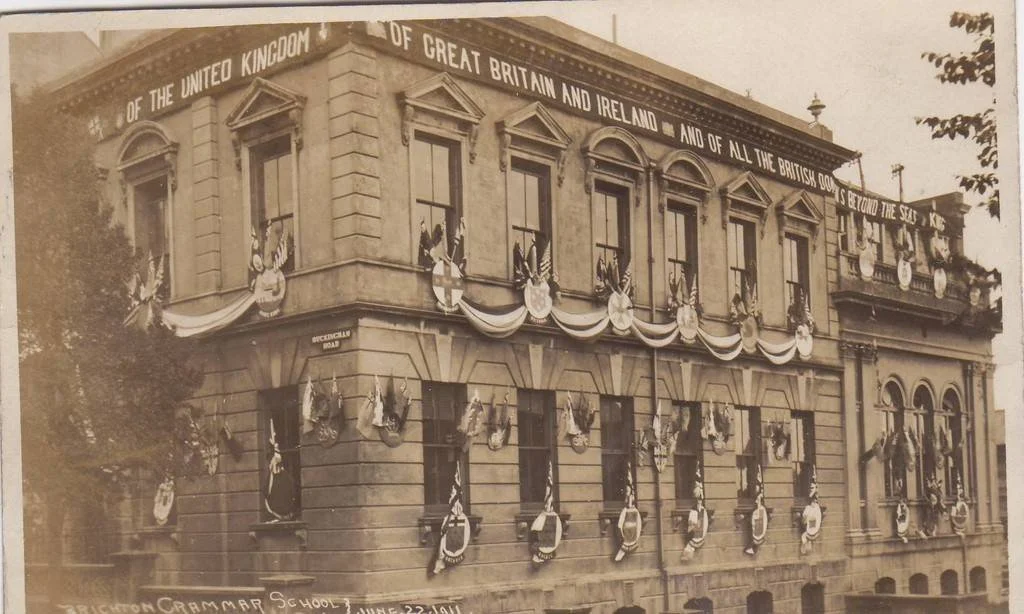
Image: The second site of Brighton Grammar School on Buckingham Road from the 1868-1920. The school moved to the current Dyke Road site in 1913, before having to return due to the war until 1920. The site pictured later became Brighton Maternity Hospital before eventually being demolished in September 1976. The replacement building has recently been demolished. The original school building is still standing.